Co-Sell Insights
Fours Insights powered by AWS Co-Sell Agents.
Overview
The Fours Widget Insights Tab uses pre-defined triggers to evaluate your opportunity data. It then surfaces actionable cards powered by AWS Co-Sell AI Agents to provide proactive guidance on deal progression, funding eligibility, and risk mitigation.
Prerequisites
To use these AI-powered features, the following must be in place:
- AWS PC 3.0 Migration: Your ACE account must be migrated to AWS Partner Central 3.0.
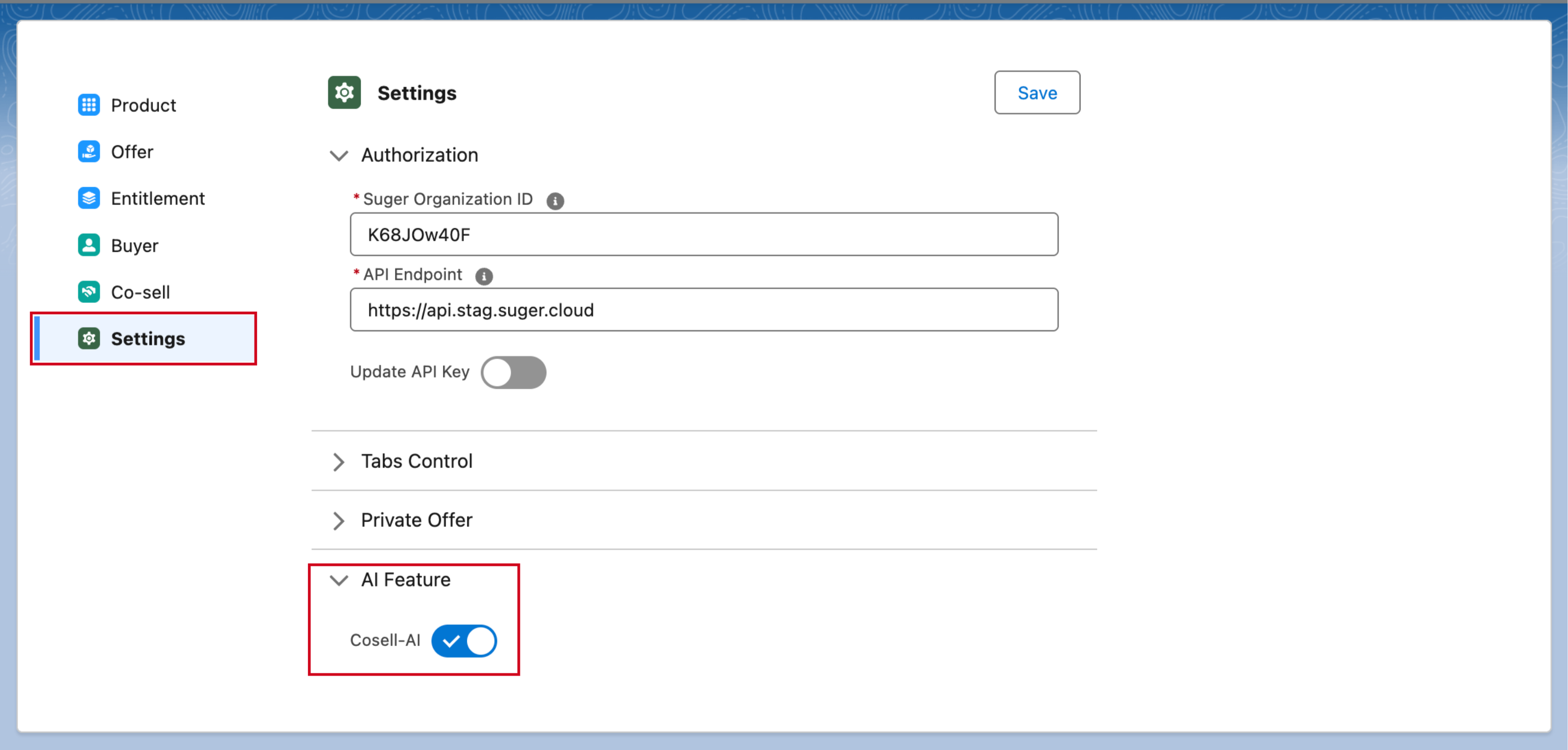
- Co-sell AI enabled by Fours: The Cosell-AI feature is switched on by Fours, not by your team. Contact support@suger.io to have it enabled for your organization.
How it Works
The Insights Tab is organized around three distinct card types, following a strict visual hierarchy:
1. Warning Cards (Fours-Computed)
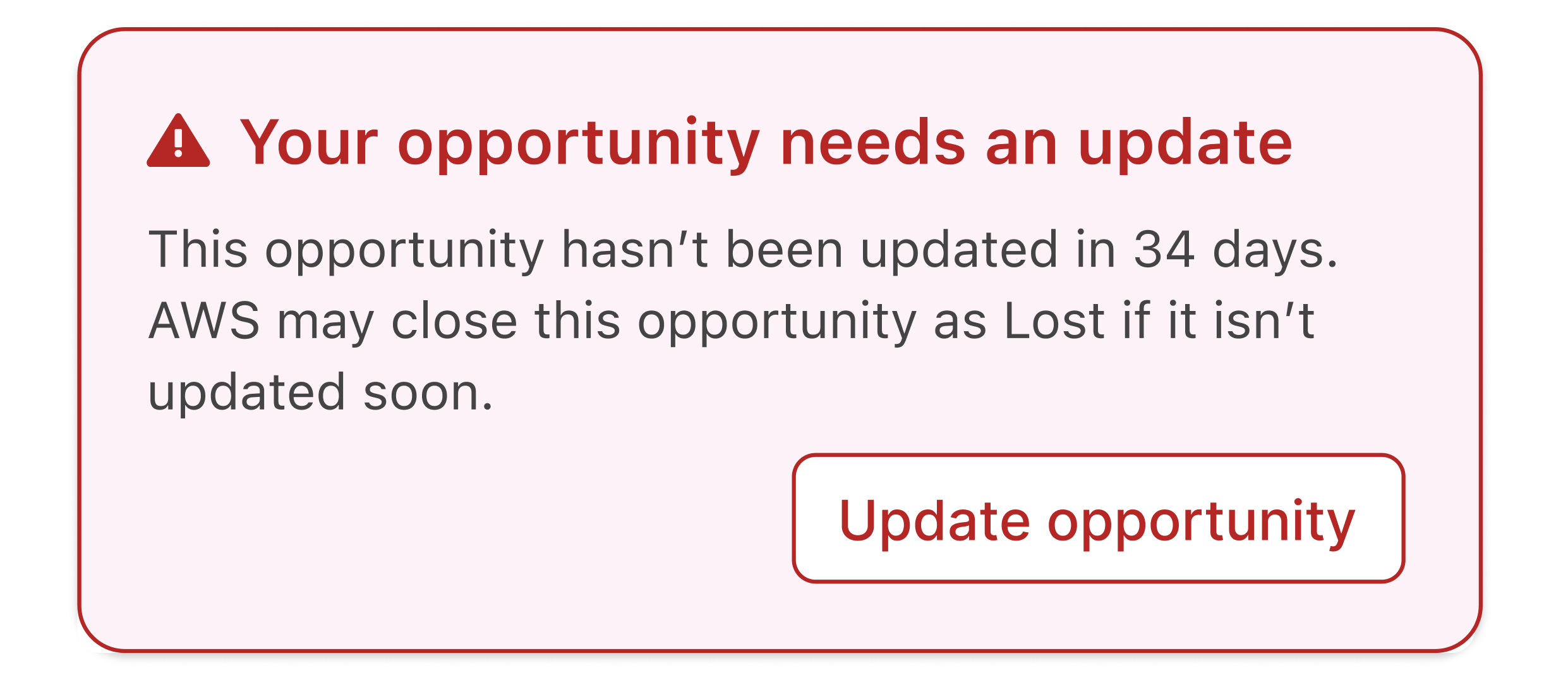
These are deterministic alerts rendered immediately at the absolute top of the AI Tab.
- Visibility: Always visible when a trigger condition is met (e.g., an opportunity hasn’t been updated in 30+ days).
- Interaction: These often include inline CTAs like “Update Close Date”. You can dismiss them for the current session, but they will reappear on your next visit if the condition persists.
2. Main Insight Cards (AWS MCP Powered)
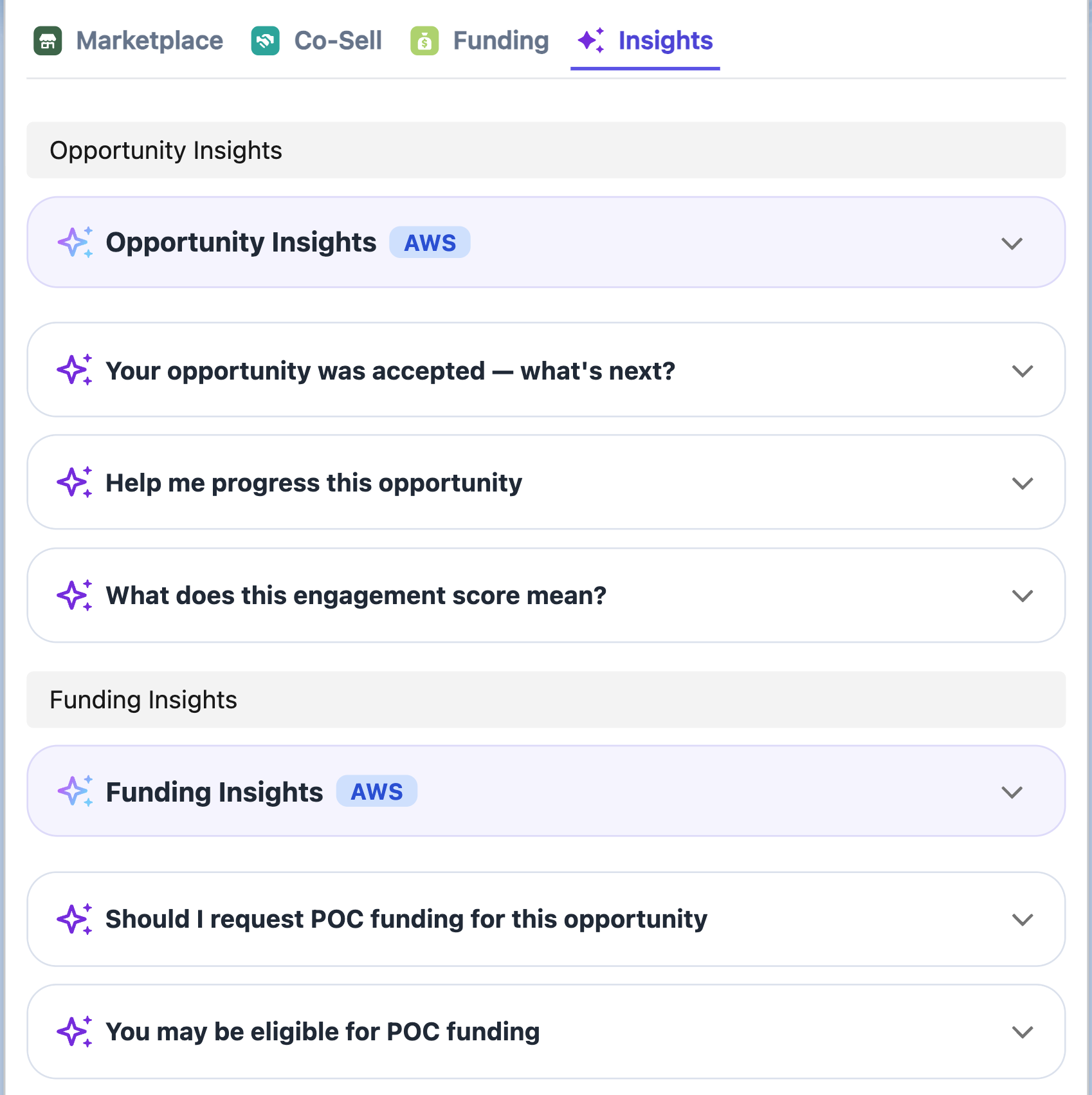
These cards are fetched from AWS MCP when the AI Tab loads and are cached for approximately 10 days.
- Opportunity Insights: Provides a summary of general opportunity health, engagement scores, and quick wins.
- Funding Insights: Surfaces eligibility for programs like POC funding or MDF (available for approved/accepted opportunities).
3. AI Trigger Cards (Recommended Actions)
These cards map to specific conditions in the AWS ACE opportunity lifecycle and appear grouped beneath their parent Insight Card.
- Interaction: Click a card (e.g., “Help me progress this opportunity”) to expand it.
- Examples: “Why was this rejected?”, “Request POC funding”, or “Get pricing and business case support”.
AWS Opportunity Quality Score
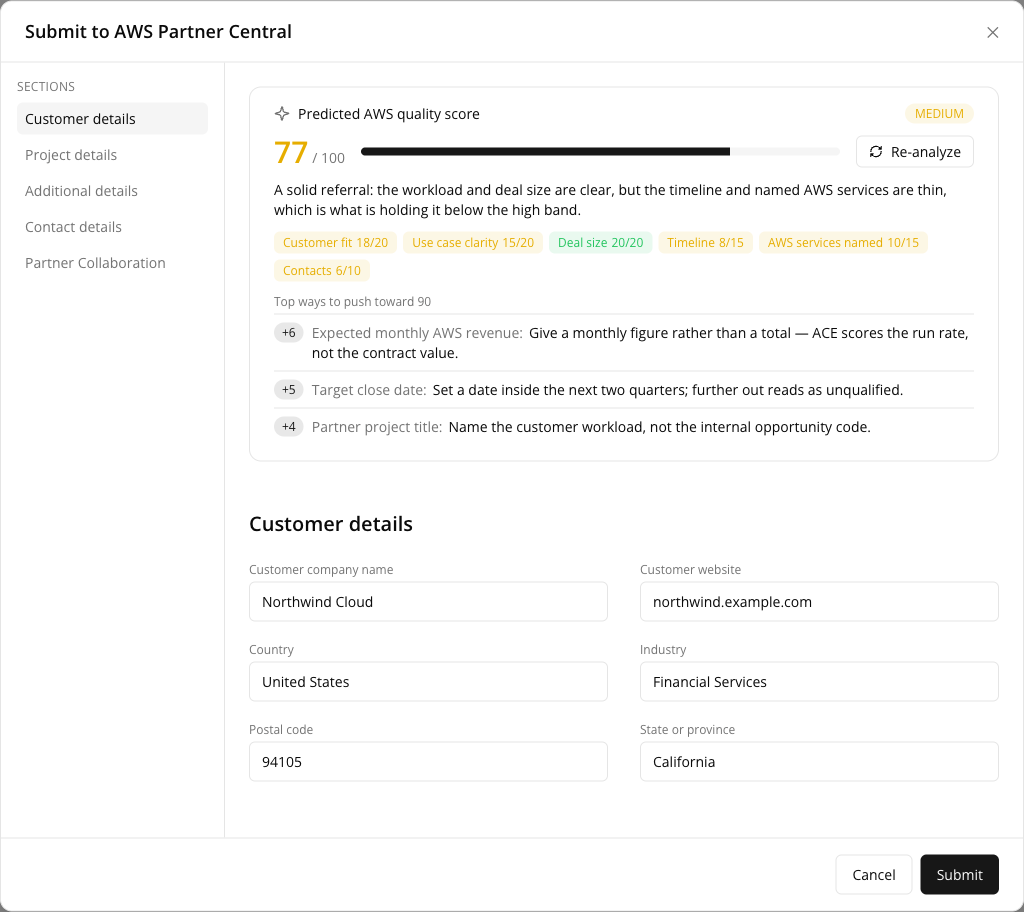
Before you submit an opportunity to ACE, Fours predicts how AWS is likely to rate its quality — so you can improve it while editing rather than after a rejection.
Where you see it
The score appears as a Predicted AWS quality score banner in the ACE submission dialog. After you change the fields the score depends on, click Re-analyze to score the opportunity again with your edits. In the HubSpot app, the same prediction appears as Predicted AWS Opportunity Quality on the Share Opportunity with AWS and Re-submit AWS Opportunity panels — see AWS: predicted quality score.
When AWS has scored the opportunity in ACE, its own score appears on the referral too. On an AWS referral’s detail page, the AWS Opportunity Quality panel at the top of the right sidebar shows AWS’s Quality Score, with the Quality Trend, the Co-Sell Motion, and the AWS Recommendation. The info icon beside the score reads AWS’s quality score for this opportunity in ACE, as reported by AWS. That score is AWS’s, not Fours’ prediction. The panel is hidden until AWS has returned at least one of these.
How the score is read
The score runs from 0 to 100 and falls into one of five bands:
| Band | Score |
|---|---|
| Lowest | 0–10 |
| Low | 11–25 |
| Medium | 26–39 |
| High | 40–49 |
| Highest | 50 and above |
The number comes from a rubric of 8 weighted dimensions evaluated across the opportunity — no single field decides it, so improving one weak area moves the score rather than transforming it.
The business-problem gate
One check overrides everything else. If the Customer Business Problem is a placeholder, too short, or reads as a pitch for your product rather than a description of the customer’s problem, the score is forced to 0 regardless of how strong the rest of the opportunity is.
That gate is deliberate: AWS partner managers read the business problem first, and a weak one sinks an otherwise good opportunity. If your score is 0, rewrite the business problem before looking at anything else.
Generate the Customer Business Problem with AI
Because the business problem carries so much weight, Fours can draft it for you. Use Generate with AI on the Customer Business Problem field.
Generate with AI is part of the ACE submission dialog for the AWS Partner Central API integration. It is not available on the deprecated legacy S3 integration.
What you get back:
- 2–4 sentences, written from the customer’s perspective — the problem they have, not the product you sell.
- Length inside AWS’s expectations. The existing rule still applies: Fours instructs the AI to produce 500–1,800 characters and truncates anything over 1,800.
If your organization has defined its own prompt for this field in the co-sell field mapping configuration, that prompt is used instead of Fours’ default — so you can steer tone and emphasis for your whole team in one place. See Field Mapping for where the prompt lives.
Engagement Score
The engagement score estimates how engaged a customer already is with a cloud partner. It is reported as one of three values:
High · Medium · Low
Fours resolves it from the best source available, in order:
- Partner — the score the cloud partner itself reports for the customer.
- Marketplace — derived from the customer’s activity on that partner’s marketplace, used when the partner reports no score.
- AI — an AI-derived estimate, used as the fallback when neither of the above is available.
The score is refreshed every 6 hours, so a newly created customer record may take a cycle before a score appears.
Two different scores, named apart
A cloud partner may score a specific opportunity itself. Where it has not, Fours predicts one instead. These are different things, so they carry different names rather than being tagged:
| What you see | What it is |
|---|---|
| Fours Predicted Engagement Score | Fours’ own prediction, from the customer’s marketplace listings and purchases and from AI analysis of third-party signals. |
| A score on the referral, under Engagement Score | The cloud partner’s own score for that opportunity. |
| Not provided by AWS | AWS has not scored this opportunity. Only AWS referrals show this, because Azure and GCP never supply a score of their own. |
Azure and GCP never supply an engagement score of their own, so a score shown for either is always Fours’ prediction.
Fours’ prediction appears in the Fours widget on the Account and Opportunity pages, under its own heading. It is deliberately not shown on an AWS referral: the referral’s score is AWS’s own, and mixing the two there is what used to make a prediction look like a number AWS had supplied. Azure and GCP referral cards in the Salesforce app have no partner score to confuse it with, so they show a row labelled Fours Predicted Engagement Score instead (N/A when Fours has no prediction).
In HubSpot, the prediction appears on the deal’s Insights tab and on the Co-sell Insights company card. See Engagement score on the Insights tab.
Only a partner score reaches your reports
This is the part worth knowing before you build a report.
In Salesforce, only the partner’s own score for that opportunity is written to the referral
record’s AWS Marketplace Engagement Score field (Suger__AWS_EngagementScore__c). The
Fours Predicted Engagement Score is calculated for display and stored against the
customer’s domain in Fours, not on the referral — so it appears in the Fours widget and is
blank in any report, list view, formula field or automation built on that field.
A blank column in a report therefore means one thing: AWS has not scored that opportunity yet. It does not mean the score was lost. The same note appears on the field itself, in the help text beside AWS Marketplace Engagement Score on the referral record.
Spotted something wrong or out of date on this page? Tell us and we'll correct it.