# Create Co-Sell
Submit a co-sell referral to AWS, Azure, GCP, or a Suger partner directly from a HubSpot deal using the Suger App.
---
## Overview
A co-sell referral is how you formally ask AWS, Azure, or GCP to work with you on a deal. When you submit a referral, the cloud provider's sales team can see the opportunity and engage to help you close it — for example, by introducing you to the right contacts, validating the opportunity, or contributing resources.
In plain terms, you're sharing a deal with your cloud partner so they can help you win it. The same button also shares a deal with a **Suger partner** — a partner connected to you through [Partner Management](/prm/) — so a referral can go to a channel partner rather than a cloud. After adding the Suger App to your HubSpot Console, you can create all of these straight from a deal.
:::info
Submitting a co-sell referral does not send anything to your customer. It only shares the deal details with the cloud provider's partner team — your customer will not know a referral was submitted.
:::
For more details, see [Co-Sell](/cosell/).
## Prerequisites
The Suger App must be set up in HubSpot and the Suger app card must be visible on your deal pages. If you haven't done that yet, see [Set up the Suger App in HubSpot](/hubspot-app/hubspot-app-configuration/).
## Create a Co-Sell
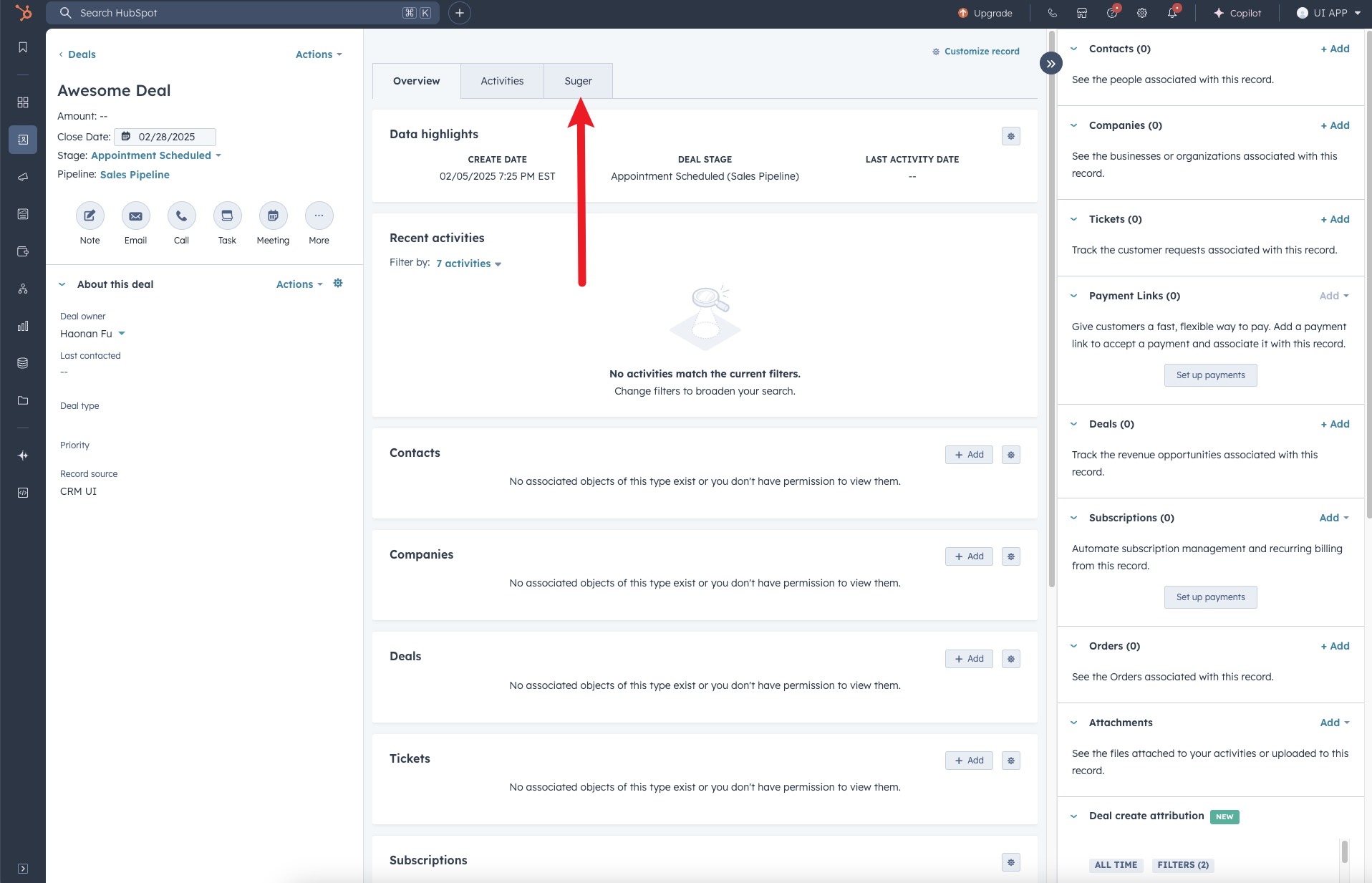
1. Navigate to the deal's detail page and click the **"Suger"** tab at the top of the page.
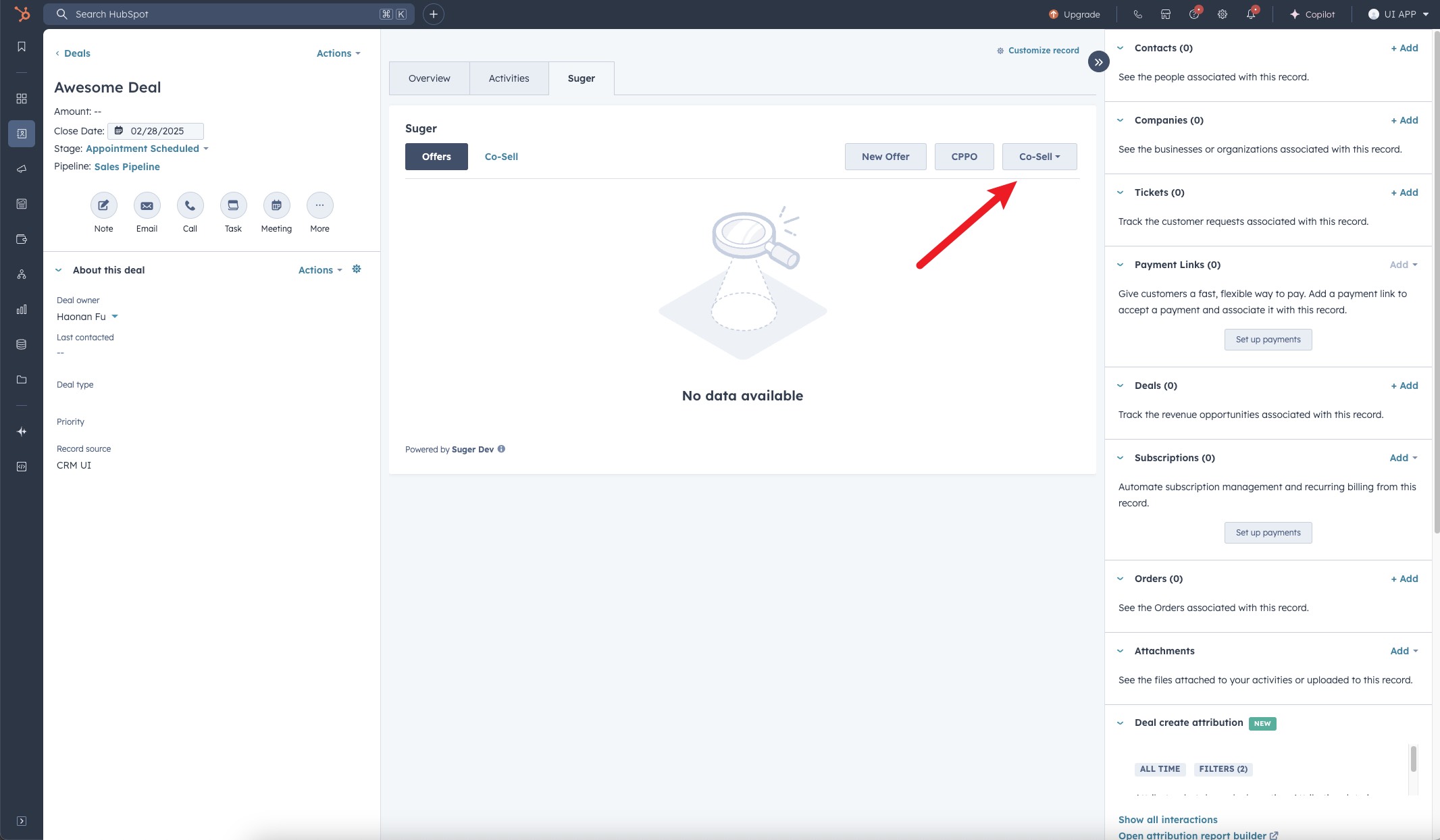
>  2. Locate and click the **"Co-Sell"** button.
>
2. Locate and click the **"Co-Sell"** button.
>  3. Choose the destination you want to submit the referral to. There are up to four: **AWS**, **AZURE**, **GCP**, and **Partner** — a partner connected to you through Suger.
>
3. Choose the destination you want to submit the referral to. There are up to four: **AWS**, **AZURE**, **GCP**, and **Partner** — a partner connected to you through Suger.
> 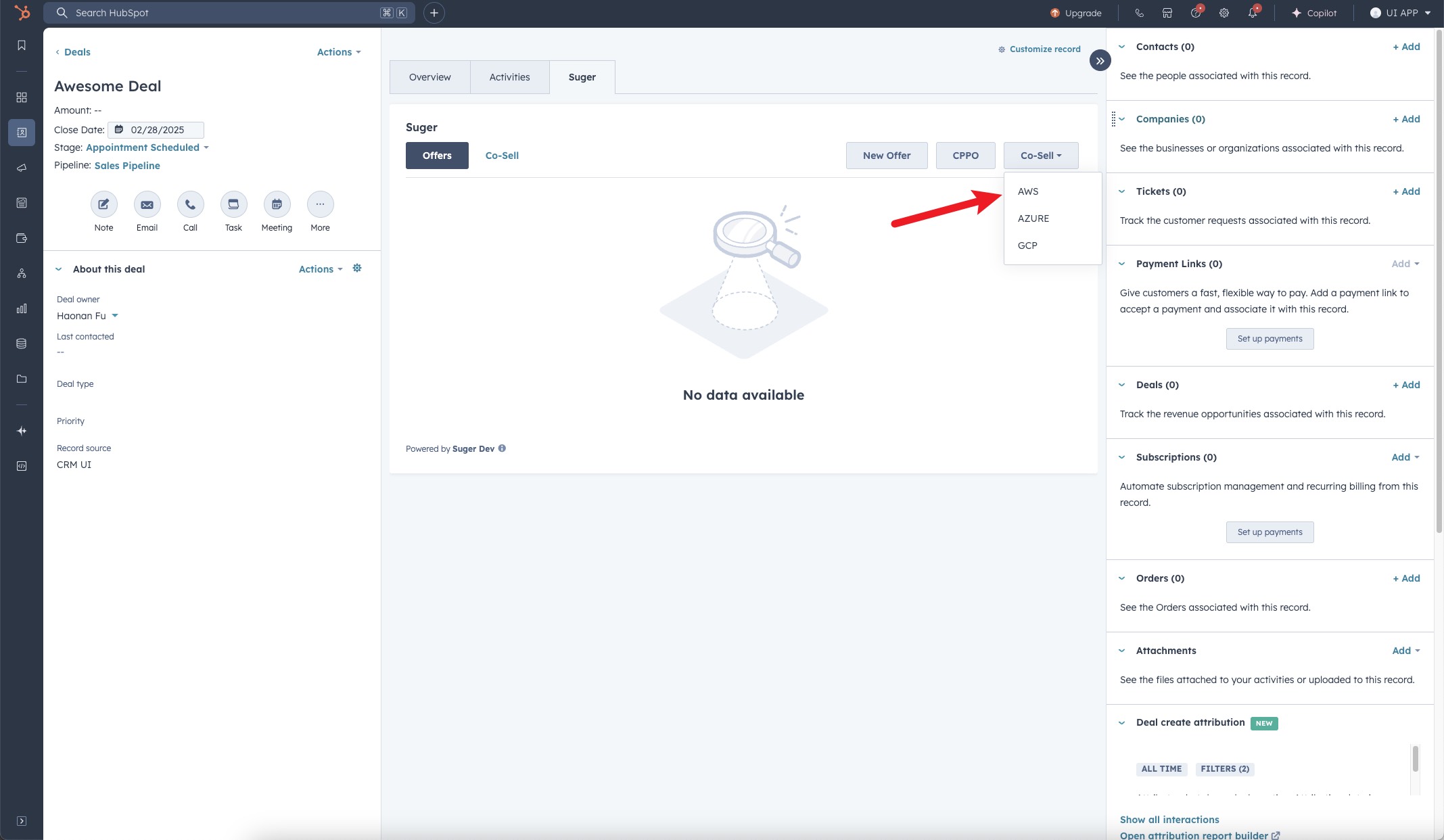 The button adapts to what your organization has connected:
- **More than one destination** — the button reads **Co-Sell** and opens a dropdown listing each one.
- **Exactly one destination** — there is no dropdown. The single entry renders as a plain **Co-Sell** button that opens that destination's form directly.
- **No destinations** — the button does not appear at all.
:::info
A destination only appears if it is configured: AWS needs an AWS integration, Azure needs co-sell enabled on the Azure integration, GCP needs the GCP co-sell service, and **Partner** appears only when your organization has connected Suger partners.
:::
If your AWS connection still uses the legacy AWS S3 API, choosing **AWS** opens an **AWS S3 API Deprecated** notice instead of the referral form: *"The AWS S3 API is no longer supported. Please contact your administrator to upgrade to the new AWS ACE API."* Ask your administrator to upgrade to the AWS ACE API — the referral form is not available until they do.
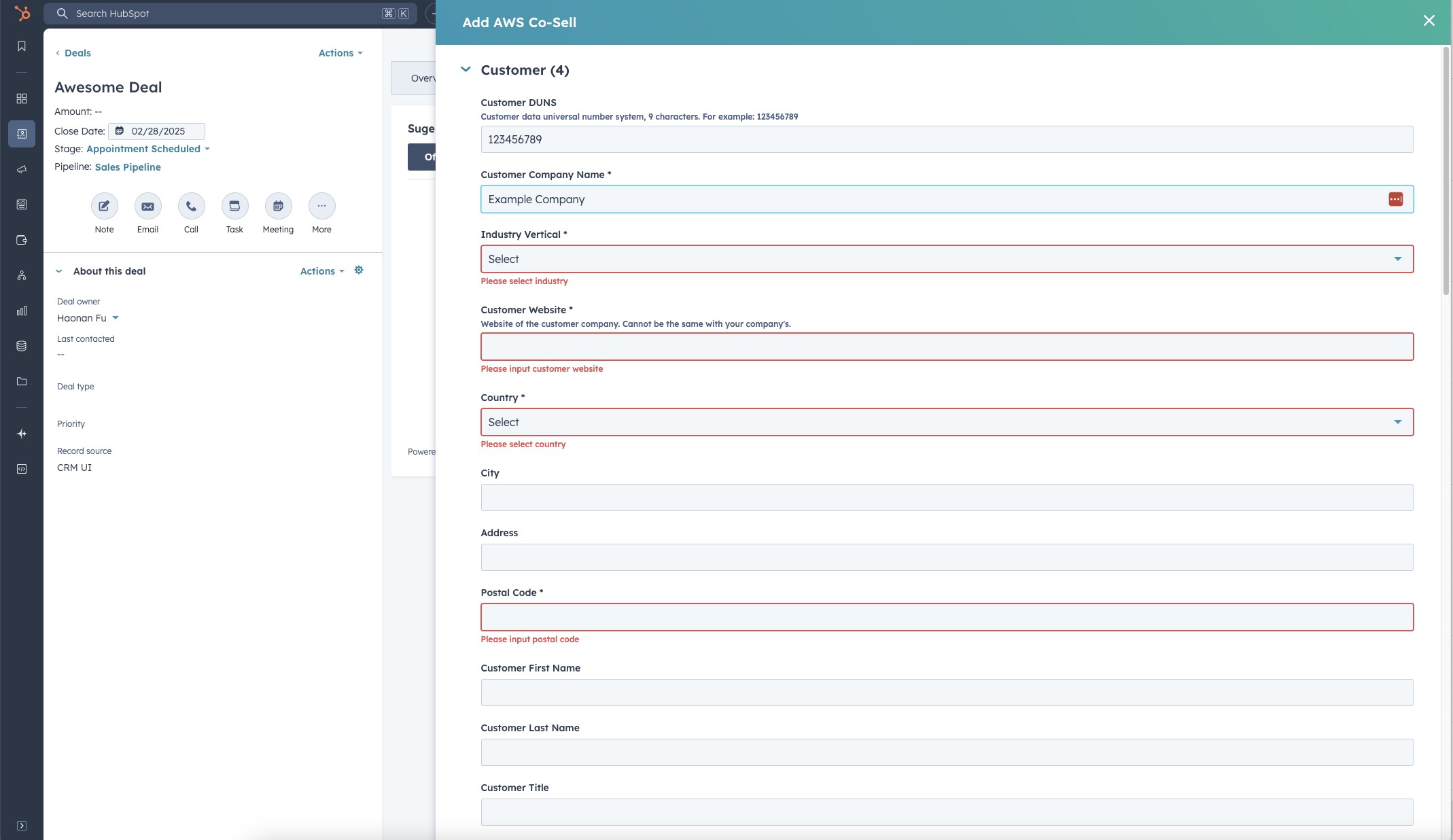
4. Complete the required fields in the form. Note that the required fields may vary depending on which cloud partner you selected.
>
The button adapts to what your organization has connected:
- **More than one destination** — the button reads **Co-Sell** and opens a dropdown listing each one.
- **Exactly one destination** — there is no dropdown. The single entry renders as a plain **Co-Sell** button that opens that destination's form directly.
- **No destinations** — the button does not appear at all.
:::info
A destination only appears if it is configured: AWS needs an AWS integration, Azure needs co-sell enabled on the Azure integration, GCP needs the GCP co-sell service, and **Partner** appears only when your organization has connected Suger partners.
:::
If your AWS connection still uses the legacy AWS S3 API, choosing **AWS** opens an **AWS S3 API Deprecated** notice instead of the referral form: *"The AWS S3 API is no longer supported. Please contact your administrator to upgrade to the new AWS ACE API."* Ask your administrator to upgrade to the AWS ACE API — the referral form is not available until they do.
4. Complete the required fields in the form. Note that the required fields may vary depending on which cloud partner you selected.
>  :::tip
If field mapping has been configured, the form will be prefilled with corresponding fields from the HubSpot deal, making the process faster and easier. Review the pre-filled values for accuracy before submitting.
:::
5. Once all necessary information is filled in, submit the form to create the Co-Sell.
>
:::tip
If field mapping has been configured, the form will be prefilled with corresponding fields from the HubSpot deal, making the process faster and easier. Review the pre-filled values for accuracy before submitting.
:::
5. Once all necessary information is filled in, submit the form to create the Co-Sell.
> 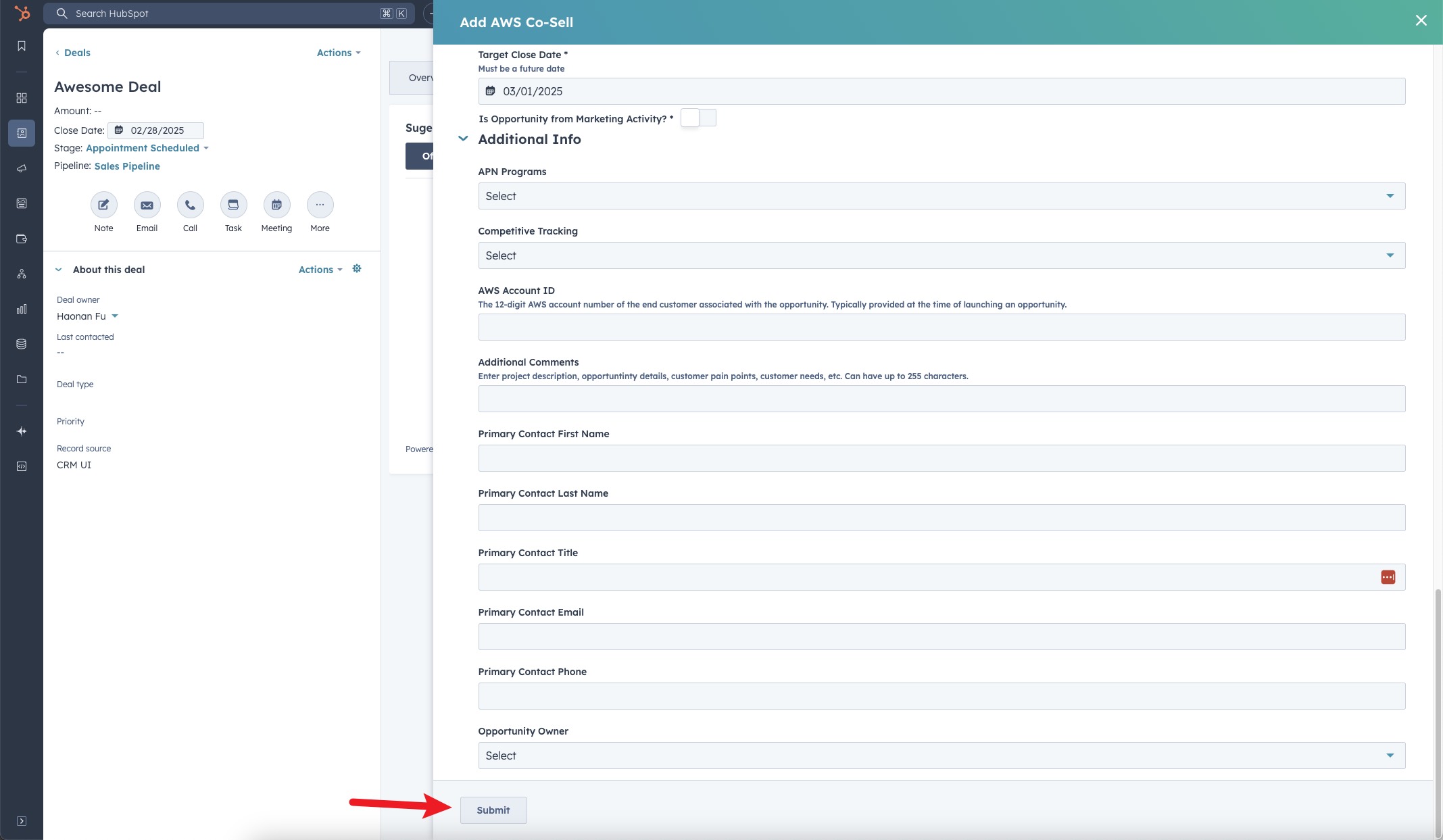 6. You are all set!
## AWS: contacts on the referral form
The AWS ACE referral form groups its contacts into three labelled sections so it is clear who is who:
| Section | Who goes here |
| --- | --- |
| **Customer contact details** | The person at the customer this opportunity is with |
| **Partner Contact - Owner** | The person on your side who owns the opportunity |
| **Additional Partner Contact - Account Manager** | An optional second person on your side |
Two behaviours worth knowing:
- **Blank partner contacts are dropped.** If you leave a partner contact section empty, it is not sent to AWS — you do not have to fill in the account manager just to submit.
- **Partner contacts are read-only when editing.** Once a referral exists, you can edit the rest of it, but the partner contacts are fixed.
## Azure: solution area and play
The Azure referral form has a **Solution Area/Play** section. Pick the solution area first, then the play underneath it; the second dropdown's placeholder is **Conversation**, and in field mapping the same field is labelled **Solution Play/Conversation**.
The solution areas are Microsoft's FY27 set:
| Solution area |
| --- |
| AI Business Solutions |
| Cloud and AI Platforms |
| Microsoft Services |
| Security |
| Windows and Devices |
:::info
Referrals saved before the FY27 change keep whatever they were submitted with. Those older values render as the saved value followed by a `(legacy)` suffix, so you can tell at a glance that the referral predates the current list. Nothing is rewritten for you; pick a current area and play the next time you edit the referral.
:::
## Azure: company lookup and team members
**The Microsoft company lookup runs on its own.** When the Azure form opens with a valid customer address, Suger searches Microsoft for the matching company automatically — you no longer need to click **Search**. If the address is incomplete, fix it and use the **Search** button as before.
**Adding team members.** The Azure form's **Add Team Member** modal takes four fields: **First Name**, **Last Name**, **Email**, and **Phone Number**.
## Share a deal with a Suger partner
Beyond the three clouds, you can share a deal with a partner connected to you through Suger — the same partnership network you manage in [Partner Management](/prm/). It is a fourth destination on the **Co-Sell** button, not a separate tab or button.
:::info
The **Partner** entry appears only if your organization has connected Suger partners. When it is the only destination available, it renders as a single **Co-Sell** button with no dropdown.
:::
### Step 1 — pick the partner
Choosing **Partner** opens the **Share Co-Sell with Partner** panel. It explains what is about to happen: *"Choose a partner connected via Suger. The selected partner will receive an inbound copy of this co-sell."*
1. Start typing in the **Partner** field. Its placeholder is *"Search by name or domain"*, so either works.
2. If there are more matches than the list shows, a hint reads *"+{n} more — keep typing to narrow the list."* Keep typing until your partner appears.
3. Select the partner and click **Continue**.
### Step 2 — complete the form
The second step is the co-sell form itself, organized into accordions:
| Accordion | What you enter |
| --- | --- |
| **Customer & Opportunity** | The customer company name, website, industry, and country, plus the opportunity type |
| **Deal Details** | Deal name, target close date, the customer's business problem, delivery model, and the deal value |
| **Revenue Share** | Commission type, revenue share model, payment trigger, and clawback window. **Shown only when you are the seller** |
| **Partner Collaboration** | What you need from the partner on this deal |
| **Team** | Your people on the deal. Use **Add Team Member** to add a row and **Remove** to drop one |
The footer has two buttons: **Back** to return to the partner picker, and **Share Co-Sell** to submit.
Two things about this form catch people out:
- **The deal role is not editable.** Whether you are the **Seller** or the **Referrer** on this co-sell is derived from your partnership relationship type with that partner — you cannot change it on the form. It also drives what you see: the **Revenue Share** accordion only appears for the Seller, and for the Referrer the deal-value field is labelled **Estimated Deal Value** rather than **Deal Value**.
- **The customer business problem has a minimum length.** It must be at least 20 characters, so a one-word answer will not submit.
Option lists used on this form:
| Field | Options |
| --- | --- |
| **Revenue Share Model** | `% of Final Transaction`, `Fixed Amount`, `To Be Defined` |
| **Deal value visibility** | `Show deal value`, `Hide deal value` |
### After you share
Partner co-sells appear in the same **Co-Sell** table as your cloud referrals, with **Partner** identifying the destination. Opening one shows a read-only **Partner Co-Sell** modal with the details as shared: **Overview**, **Customer**, **Deal**, **Revenue Share**, and **Team**.
## Track referrals on the Co-Sell tab
The **Co-Sell** tab lists every referral raised from this deal, cloud and partner alike:
| Column | What it shows |
| --- | --- |
| **Name** | The opportunity name. Click it to open the referral's detail modal |
| **ID** | The referral identifier |
| **Partner** | Where it was submitted — AWS, Azure, GCP, or a Suger partner |
| **Direction** | Whether the referral is outbound (you shared it) or inbound (it was shared with you) |
| **Status** | Where the referral stands with that partner |
| **Create Date** | When the referral was created |
| **Last Activity Date** | When it last changed |
**Failed updates are flagged on the row.** If an AWS referral is in **UPDATE_FAILED**, an error badge appears next to its name. Hover it and the tooltip shows the raw failure message returned by AWS, which is usually enough to tell you which field to correct before resubmitting.
## What happens next
After you submit the referral:
- Suger creates the referral and links it to the HubSpot deal.
- The referral is sent to the cloud partner's system — for example, AWS Partner Central (ACE), Azure Partner Center, or GCP Partner Advantage. If you shared it with a Suger partner instead, that partner receives an inbound copy of the co-sell.
- The cloud partner reviews the referral and may accept, reject, or request more information.
- Any future updates Suger syncs from your HubSpot deal are automatically reflected on the referral — you do not need to manually push updates to the cloud partner.
- The referral is also visible in the Suger Console under your referrals list.
## Troubleshooting common issues
| Issue | Possible cause | Resolution |
| --- | --- | --- |
| No Suger tab visible on the deal page | The Suger app card has not been added to the deal layout | Set up the Suger App in HubSpot to add the app card |
| No Co-Sell button visible inside the Suger panel | The HubSpot integration connection has been disrupted | Go to Suger Console → Settings → Integrations → HubSpot and click Verify to re-verify the connection |
| Only one or two destinations appear in the selector | Your Suger account may not have co-sell configured for all clouds | Contact your Suger admin to confirm which cloud partners are enabled for co-sell. With exactly one destination there is no dropdown at all — a single **Co-Sell** button is the expected behaviour |
| **Partner** is missing from the selector | Your organization has no connected Suger partners | The **Partner** destination only appears once a partnership exists. See [Partner Management](/prm/) |
| Choosing **AWS** opens an "AWS S3 API Deprecated" notice | The AWS connection still uses the legacy AWS S3 API | Ask your administrator to upgrade the integration to the AWS ACE API. The referral form is unavailable until then |
| Form fields are blank — not pre-filled from the deal | Field mapping has not been configured | Field mapping is an optional admin setup. Contact your admin to configure it |
| Referral was submitted but is not visible on the deal | Sync between Suger and HubSpot is delayed | Refresh the page after a few minutes. If it still doesn't appear, confirm the referral was created in the Suger Console |
## Frequently Asked Questions (FAQs)
- **Q: What's the difference between a co-sell referral and a private offer?**
**A:** A co-sell referral shares your deal with the cloud provider's partner team so they can help you close it. A private offer is a custom-priced contract you send directly to a buyer. They serve different purposes — co-sell is about getting the cloud partner involved in the deal; a private offer is the actual transaction.
- **Q: Can I submit a referral to more than one cloud partner for the same deal?**
**A:** Yes. You can submit separate co-sell referrals to AWS, Azure, and GCP from the same HubSpot deal — just click **Co-Sell** again and select a different partner.
- **Q: Do I need to manually update the referral every time the deal changes in HubSpot?**
**A:** No. Suger automatically syncs changes from your HubSpot deal to the referral. If you update mapped fields on the deal, those changes flow through to the cloud partner automatically.
- **Q: Will the co-sell referral show up in the Suger Console too?**
**A:** Yes. Any referral created from HubSpot is also visible in the Suger Console under your referrals list.
6. You are all set!
## AWS: contacts on the referral form
The AWS ACE referral form groups its contacts into three labelled sections so it is clear who is who:
| Section | Who goes here |
| --- | --- |
| **Customer contact details** | The person at the customer this opportunity is with |
| **Partner Contact - Owner** | The person on your side who owns the opportunity |
| **Additional Partner Contact - Account Manager** | An optional second person on your side |
Two behaviours worth knowing:
- **Blank partner contacts are dropped.** If you leave a partner contact section empty, it is not sent to AWS — you do not have to fill in the account manager just to submit.
- **Partner contacts are read-only when editing.** Once a referral exists, you can edit the rest of it, but the partner contacts are fixed.
## Azure: solution area and play
The Azure referral form has a **Solution Area/Play** section. Pick the solution area first, then the play underneath it; the second dropdown's placeholder is **Conversation**, and in field mapping the same field is labelled **Solution Play/Conversation**.
The solution areas are Microsoft's FY27 set:
| Solution area |
| --- |
| AI Business Solutions |
| Cloud and AI Platforms |
| Microsoft Services |
| Security |
| Windows and Devices |
:::info
Referrals saved before the FY27 change keep whatever they were submitted with. Those older values render as the saved value followed by a `(legacy)` suffix, so you can tell at a glance that the referral predates the current list. Nothing is rewritten for you; pick a current area and play the next time you edit the referral.
:::
## Azure: company lookup and team members
**The Microsoft company lookup runs on its own.** When the Azure form opens with a valid customer address, Suger searches Microsoft for the matching company automatically — you no longer need to click **Search**. If the address is incomplete, fix it and use the **Search** button as before.
**Adding team members.** The Azure form's **Add Team Member** modal takes four fields: **First Name**, **Last Name**, **Email**, and **Phone Number**.
## Share a deal with a Suger partner
Beyond the three clouds, you can share a deal with a partner connected to you through Suger — the same partnership network you manage in [Partner Management](/prm/). It is a fourth destination on the **Co-Sell** button, not a separate tab or button.
:::info
The **Partner** entry appears only if your organization has connected Suger partners. When it is the only destination available, it renders as a single **Co-Sell** button with no dropdown.
:::
### Step 1 — pick the partner
Choosing **Partner** opens the **Share Co-Sell with Partner** panel. It explains what is about to happen: *"Choose a partner connected via Suger. The selected partner will receive an inbound copy of this co-sell."*
1. Start typing in the **Partner** field. Its placeholder is *"Search by name or domain"*, so either works.
2. If there are more matches than the list shows, a hint reads *"+{n} more — keep typing to narrow the list."* Keep typing until your partner appears.
3. Select the partner and click **Continue**.
### Step 2 — complete the form
The second step is the co-sell form itself, organized into accordions:
| Accordion | What you enter |
| --- | --- |
| **Customer & Opportunity** | The customer company name, website, industry, and country, plus the opportunity type |
| **Deal Details** | Deal name, target close date, the customer's business problem, delivery model, and the deal value |
| **Revenue Share** | Commission type, revenue share model, payment trigger, and clawback window. **Shown only when you are the seller** |
| **Partner Collaboration** | What you need from the partner on this deal |
| **Team** | Your people on the deal. Use **Add Team Member** to add a row and **Remove** to drop one |
The footer has two buttons: **Back** to return to the partner picker, and **Share Co-Sell** to submit.
Two things about this form catch people out:
- **The deal role is not editable.** Whether you are the **Seller** or the **Referrer** on this co-sell is derived from your partnership relationship type with that partner — you cannot change it on the form. It also drives what you see: the **Revenue Share** accordion only appears for the Seller, and for the Referrer the deal-value field is labelled **Estimated Deal Value** rather than **Deal Value**.
- **The customer business problem has a minimum length.** It must be at least 20 characters, so a one-word answer will not submit.
Option lists used on this form:
| Field | Options |
| --- | --- |
| **Revenue Share Model** | `% of Final Transaction`, `Fixed Amount`, `To Be Defined` |
| **Deal value visibility** | `Show deal value`, `Hide deal value` |
### After you share
Partner co-sells appear in the same **Co-Sell** table as your cloud referrals, with **Partner** identifying the destination. Opening one shows a read-only **Partner Co-Sell** modal with the details as shared: **Overview**, **Customer**, **Deal**, **Revenue Share**, and **Team**.
## Track referrals on the Co-Sell tab
The **Co-Sell** tab lists every referral raised from this deal, cloud and partner alike:
| Column | What it shows |
| --- | --- |
| **Name** | The opportunity name. Click it to open the referral's detail modal |
| **ID** | The referral identifier |
| **Partner** | Where it was submitted — AWS, Azure, GCP, or a Suger partner |
| **Direction** | Whether the referral is outbound (you shared it) or inbound (it was shared with you) |
| **Status** | Where the referral stands with that partner |
| **Create Date** | When the referral was created |
| **Last Activity Date** | When it last changed |
**Failed updates are flagged on the row.** If an AWS referral is in **UPDATE_FAILED**, an error badge appears next to its name. Hover it and the tooltip shows the raw failure message returned by AWS, which is usually enough to tell you which field to correct before resubmitting.
## What happens next
After you submit the referral:
- Suger creates the referral and links it to the HubSpot deal.
- The referral is sent to the cloud partner's system — for example, AWS Partner Central (ACE), Azure Partner Center, or GCP Partner Advantage. If you shared it with a Suger partner instead, that partner receives an inbound copy of the co-sell.
- The cloud partner reviews the referral and may accept, reject, or request more information.
- Any future updates Suger syncs from your HubSpot deal are automatically reflected on the referral — you do not need to manually push updates to the cloud partner.
- The referral is also visible in the Suger Console under your referrals list.
## Troubleshooting common issues
| Issue | Possible cause | Resolution |
| --- | --- | --- |
| No Suger tab visible on the deal page | The Suger app card has not been added to the deal layout | Set up the Suger App in HubSpot to add the app card |
| No Co-Sell button visible inside the Suger panel | The HubSpot integration connection has been disrupted | Go to Suger Console → Settings → Integrations → HubSpot and click Verify to re-verify the connection |
| Only one or two destinations appear in the selector | Your Suger account may not have co-sell configured for all clouds | Contact your Suger admin to confirm which cloud partners are enabled for co-sell. With exactly one destination there is no dropdown at all — a single **Co-Sell** button is the expected behaviour |
| **Partner** is missing from the selector | Your organization has no connected Suger partners | The **Partner** destination only appears once a partnership exists. See [Partner Management](/prm/) |
| Choosing **AWS** opens an "AWS S3 API Deprecated" notice | The AWS connection still uses the legacy AWS S3 API | Ask your administrator to upgrade the integration to the AWS ACE API. The referral form is unavailable until then |
| Form fields are blank — not pre-filled from the deal | Field mapping has not been configured | Field mapping is an optional admin setup. Contact your admin to configure it |
| Referral was submitted but is not visible on the deal | Sync between Suger and HubSpot is delayed | Refresh the page after a few minutes. If it still doesn't appear, confirm the referral was created in the Suger Console |
## Frequently Asked Questions (FAQs)
- **Q: What's the difference between a co-sell referral and a private offer?**
**A:** A co-sell referral shares your deal with the cloud provider's partner team so they can help you close it. A private offer is a custom-priced contract you send directly to a buyer. They serve different purposes — co-sell is about getting the cloud partner involved in the deal; a private offer is the actual transaction.
- **Q: Can I submit a referral to more than one cloud partner for the same deal?**
**A:** Yes. You can submit separate co-sell referrals to AWS, Azure, and GCP from the same HubSpot deal — just click **Co-Sell** again and select a different partner.
- **Q: Do I need to manually update the referral every time the deal changes in HubSpot?**
**A:** No. Suger automatically syncs changes from your HubSpot deal to the referral. If you update mapped fields on the deal, those changes flow through to the cloud partner automatically.
- **Q: Will the co-sell referral show up in the Suger Console too?**
**A:** Yes. Any referral created from HubSpot is also visible in the Suger Console under your referrals list.